
AI-Driven API Design goes on the road
The principles haven't changed. The process has.

For regular readers, you may have noticed that I’ve been writing less here on Substack lately. That’s because I’ve been deep into writing my latest O’Reilly book, “AI-Driven API Design”. The book grew out of the workshops of the same name that I’ve been presenting over the past year. Now that the manuscript is taking shape, I’m taking the newly updated workshop on the road again.
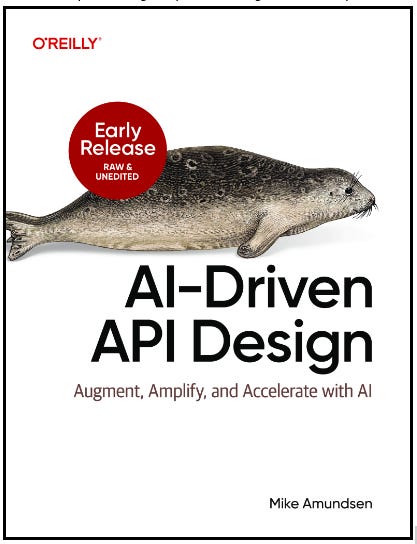
As AI becomes part of everyday software development, both this workshop and my forthcoming O’Reilly book explore a simple question:
What does good API design look like in the age of AI?
The fundamentals haven’t changed. Every successful API still begins with understanding the problem domain, identifying the people and systems involved, capturing intended behavior, and designing interfaces that are clear, reliable, and easy to evolve over time.
What has changed is the design process itself and the tools at our disposal. AI can help us discover, model, document, implement, and validate designs in ways that were impractical or too costly just a few years ago. This is an opportunity to preserve quality while reducing the effort required to get from idea to install.
Those are the ideas I’ve been exploring in my forthcoming O’Reilly book, “AI-Driven API Design”, and they’re the foundation for this workshop tour.
In the workshop, we’ll work through a complete AI-assisted design process together. Starting with domain discovery and API Stories, we’ll move through ALPS, OpenAPI, behavioral testing, and traceability to see how intended behavior can be preserved from the first design conversation through running software. Along the way, we’ll explore how each design artifact contributes to APIs that humans and AI agents can understand, trust, and use with confidence.
If you’ll be at one of these public events, I’d love to see you there. Follow the links for registration.
September 1 — API World (Santa Clara, CA) Discount: MasterWorkshop
September 17 — O’Reilly Live (Online)
September 23 — We Are Developers World Congress North America (San Jose, CA)
October 1 — API Conference New York (New York, NY) Discount: Join_APINY26
November 20 — API Conference Berlin (Berlin, Germany)

The conversations that emerge during this tour will also help shape the final stages of the book. If you’ll be attending one of these events, I hope you’ll stop by and share your own perspective on what good API design looks like in the age of AI.
Finally, if your organization or event is interested in hosting this workshop, or if there’s a city where you’d like to see it offered, let me know. I’d enjoy bringing the conversation to your community.
I am looking forward to the book Mike, really enjoyed your talk at the Arc Of AI conference this year in Austin. I recently wrote an application using publicly available data around soccer players and had to resort to scraping websites.
One of the things I'm struggling with is that for APIs to be Agentic they also have to be cost effective. If I use an API to access wikipedia data I'm willing to spend some money to access it, however if you have to get a subscription for every single resource you access it quickly becomes way too expensive as well as cumbersome for some agents to access.
Scraping websites is an awful way to consume data as I'm not consuming any of the ads or ways that platforms generate revenue. I think the OpenClaw model is extremely bad.
It seems to me that there should be a standard within the APIs that allows you to pass in anonymous generated customer key from an aggregator that the API provider can use to register usage events with a central service that provides a service to consumers/subscribers and revenue to API providers. Same for an API that provides information as well as a referral key for any sales it generates.
Curious about your thoughts on this subject